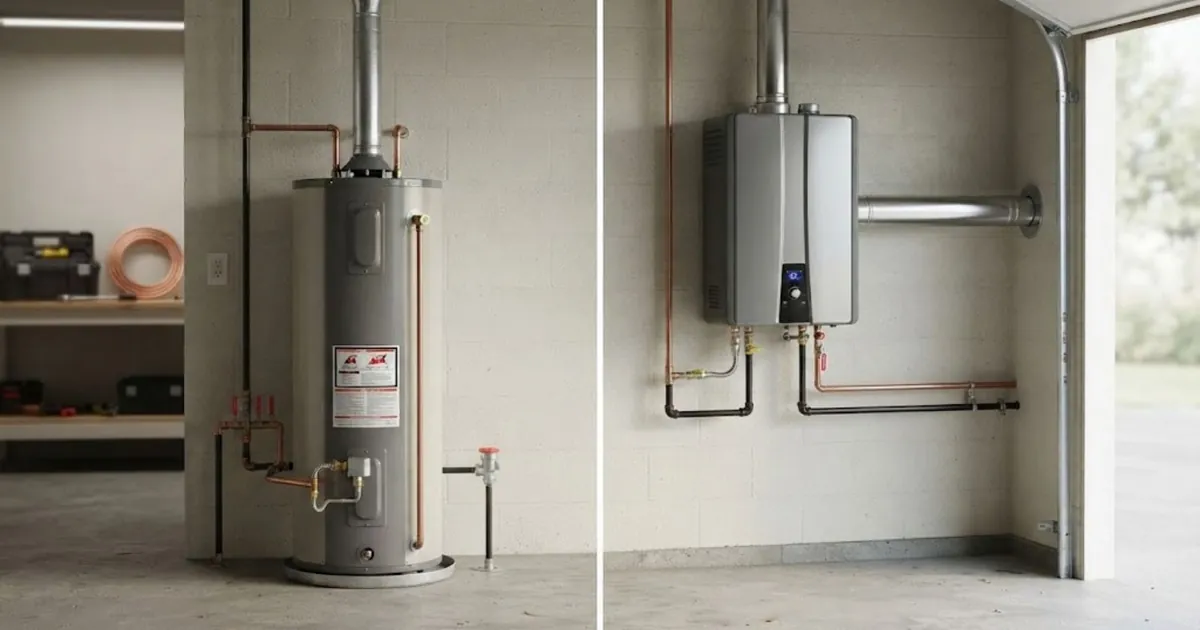
Tank vs tankless, side by side
These are general comparisons for a typical Meridian single-family home on natural gas.
| Factor | Tank (40 to 50 gallon) | Tankless (gas) |
|---|---|---|
| Upfront cost | Lower | Higher, often much higher with gas and vent upgrades. |
| Hot water supply | Limited by tank size and recovery | Continuous at its rated flow. |
| Gas line | Usually fine as is | Often needs a larger line from the meter. |
| Venting | Standard vent | Dedicated venting, sometimes a new route. |
| Hard water maintenance | Flush once or twice a year | Descale on a schedule, often yearly or more. |
| Space | Floor space in garage or closet | Wall-mounted, frees floor space. |
| Typical lifespan | Often 8 to 12 years in hard water | Often longer when maintained. |
General trade-offs. Your home's gas line, venting, and space determine the actual options.
How hard water affects each type
A tank heater tolerates scale by collecting it. Sediment settles at the bottom, and while it causes noise and wasted energy, the tank keeps working until corrosion finally wins. Flushing removes much of it.
A tankless unit heats water as it passes through narrow passages in a heat exchanger. Scale that forms there restricts flow and traps heat, which triggers error codes and can damage the exchanger. Manufacturers generally require maintenance to keep warranty coverage, and hard water areas need it more often.
That is why a softener often comes up in the same conversation. With softened water, a tankless unit's descaling interval stretches out considerably. Without one, in Zone 1 at 10.53 grains, plan on descaling at least yearly.
Five questions that usually decide it
Answer these honestly and the choice gets clearer.
- Do you run out of hot water now? If not, a tankless unit solves a problem you do not have.
- Is your gas line sized for a tankless unit? If not, add the upgrade to the price.
- Will you descale on schedule, or pay someone to? If not, a tank is the safer pick.
- Do you have or plan a softener? It makes tankless far easier to live with.
- How long will you stay in the home? Tankless savings take years to pay back the higher cost.
The gas line question
A tank heater might draw 40,000 BTU per hour. A whole-house tankless unit can draw four to five times that at full output. The gas piping from the Intermountain Gas meter to the heater has to deliver that volume, and in many homes it cannot without upsizing.
Gas piping in Idaho is licensed under the state's HVAC board, which has a specialty license for fuel gas piping. If your project needs a larger line, that work is permitted, pressure tested, and inspected before the new heater is lit.
Where tankless tends to fit best locally
Larger homes with long runs to distant bathrooms, big soaking tubs, or several showers running at once are where tankless earns its cost. Many of the custom homes in Eagle use tankless units or two tanks for exactly that reason.
A typical three-bedroom Meridian home with one or two bathrooms usually does well with a properly sized 50 gallon tank, flushed once or twice a year.
Which fits your household
Household size and habits usually point clearly one way or the other.
| Household | Typical fit | Why |
|---|---|---|
| One or two people, one bathroom | 40 gallon tank | Low demand, lowest cost, simple maintenance. |
| Three or four people, two bathrooms | 50 gallon tank or a heat pump tank | Covers back-to-back showers at a reasonable cost. |
| Four or more people, frequent simultaneous showers | Tankless or a larger tank | Continuous supply matters more than upfront cost. |
| Large home with a soaking tub or far bathrooms | Tankless, two tanks, or a tank with recirculation | Volume and distance both drive the choice. |
General guidance for Meridian homes on natural gas. Your usage and budget decide.
Whatever you choose, size by first-hour rating for tanks or by flow rate at your winter groundwater temperature for tankless. A tankless unit rated for a certain flow in warm climates delivers less when incoming water is cold.
Questions to ask before you approve a quote
Whichever type you choose, these questions keep surprises off the final bill.
- Is the price for the heater alone, or does it include permit, removal, and haul-away?
- Will the gas line or venting need changes, and are those included?
- Is a thermal expansion tank or drain pan needed, and is it in the price?
- For tankless, will service valves be installed so descaling is easy later?
- What does the manufacturer's warranty require for maintenance in hard water?
Getting these answers in writing makes quotes easy to compare side by side.
Next steps
If you are replacing a failed heater today, a like-for-like tank is usually a same-day job and gets hot water back fastest. Our water heater replacement service covers tank, heat pump, and tankless options with a free estimate on planned swaps.
If you already have a tankless unit that is throwing error codes or running lukewarm, descaling often restores it. Our tankless water heater service explains what that visit involves.
Meridian notes: rebates and the gas line permit
Intermountain Gas pays $325 on a Tier I tankless water heater rated at least 0.91 UEF, as long as the home uses natural gas for water heating after the install. Idaho Power pays $300 on a hybrid heat pump water heater, Tier 2 and 55 gallons or less, when it replaces an electric resistance tank.
Tankless conversions often need a larger gas line. In an existing Meridian home, replacing or adding gas lines falls under the city's residential mechanical Existing/Remodel permit, called R-RETRO, rather than a plumbing permit.
The same rebate rules apply to customers of those utilities in Boise, though Boise permits go through Boise's own building department.