Signs it is time to replace, not repair
Some heaters are worth fixing. These signs mean the money is better spent on a new unit.
- Water is leaking from the body of the tank, not from a fitting or valve.
- The heater is more than 10 to 12 years old and needs a major part.
- Hot water comes out rusty even after an anode rod change.
- The base of the tank is rusted or the burner area shows corrosion.
- You are running out of hot water because the household has grown.
If you are not sure, a water heater repair visit will tell you whether a fix is worth it. We will not replace a heater that a reasonable repair can save.
Your options for a new water heater
Most Meridian homes use a 40 or 50 gallon tank in the garage. Replacing like for like is the simplest and least expensive choice, but it is not the only one.
| Type | Good fit for | Trade-offs |
|---|---|---|
| Gas tank | Homes already on Intermountain Gas | Fast recovery, needs proper venting. |
| Electric tank | Homes without gas service | Simple install, slower recovery. |
| Heat pump electric | Garages with space and airflow | Lowest electric running cost, higher upfront price, cools the garage slightly. |
| Tankless gas | Households that run out of hot water | Endless hot water, needs gas line and venting upgrades, descaling in hard water. |
Trade-offs are general. Your plumber will confirm what fits your home's gas, power, and space.
A heat pump water heater is worth asking about if your home is all electric on Idaho Power. It moves heat from the surrounding air instead of heating an element directly, which cuts running costs. It needs clearance around it and a condensate drain.
Sizing a heater for a Meridian household
Tank size matters less than the first-hour rating on the label. That number tells you how much hot water the heater can deliver in a busy hour, such as two showers and a load of laundry back to back.
A household of two usually does well with a 40 gallon tank. Three to four people often need 50 gallons. Larger families with a soaking tub may need more capacity or a tankless unit.
Meridian's water is hard, running from about 7 to 10.5 grains per gallon depending on your zone. That does not change the size you need, but it does affect how long the heater lasts. If your home has no softener, a new heater is a good time to think about one.
Many homes built during the 2000s growth wave in Kuna are now on their first replacement, often with the original tank still in the garage. The same is true in Meridian neighborhoods from that era, such as Heritage Commons, which Brighton Corporation began in 2003.
If the tank failed because hard water shortened its life, adding a water softener protects the new one.
Across Ada County, many heater replacements happen in the garage, whether the house sits near Old Town Meridian or north of Chinden.
In neighborhoods like BridgeTower, where construction began in 2002, many garages still hold a second- or even first-generation tank that is due for replacement.
What happens on installation day
Most straightforward tank replacements are finished the same day. The plumber drains and disconnects the old heater, sets the new one on a stand or pan, and reconnects the water lines.
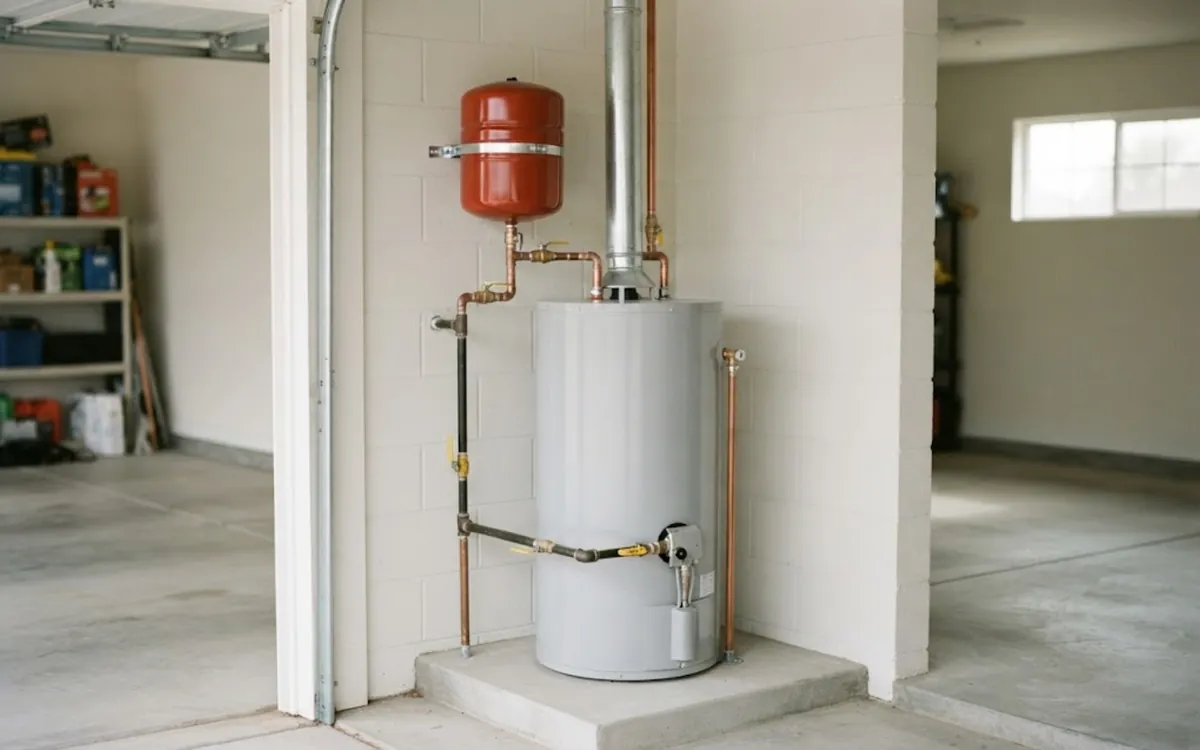
Then comes the part that separates a proper install from a quick swap, and it is where the Uniform Plumbing Code (UPC) does most of its work. The gas line or electrical connection is checked, venting is confirmed for gas units, a new relief valve discharge line is run, and a thermal expansion tank is added or checked where the plumbing system needs one.
Water heater replacement is permitted work in Idaho. Inside Meridian city limits, the permit and inspection run through Meridian Building Services. The old heater is hauled away when the job is done.
What determines the price of a new water heater
Two replacements that look alike can be priced differently. Here is why.
- The type and size of heater you choose.
- Whether venting, gas piping, or wiring needs updating to meet code.
- Adding an expansion tank, drain pan, or new shutoff valve.
- Access, since a crawl space or attic install takes more labor than a garage.
- Permit and inspection, plus removal of the old unit.
Planned replacements get a free estimate. For a leaking tank, you get the price on site before work starts. Call (208) 679-8357 to set either one up.
Matching first-hour rating to how your home uses water
The first-hour rating on the yellow label tells you how much hot water a heater can deliver in a busy hour. These are rough targets for Meridian households.
| Household | Busy-hour pattern | Suggested first-hour rating |
|---|---|---|
| One or two people | One shower plus a dishwasher | Around 50 to 60 gallons. |
| Three or four people | Two back-to-back showers plus laundry | Around 65 to 80 gallons. |
| Five or more people | Several showers in a row, soaking tub | 80 gallons or more, or tankless. |
General guidance. Showers, tub size, and appliance use change the right number.
If you often run out of hot water in the morning, the old heater may have been undersized from the start, or sediment may have reduced its usable capacity. Both are worth checking before choosing a replacement size.
Is a heat pump water heater right for your garage?
Heat pump water heaters pull warmth from the surrounding air. In a Meridian garage that stays reasonably mild, they work well for much of the year. In the coldest weeks they switch to their backup electric element more often, which raises running costs during those weeks.
They need more space than a standard tank, clearance around the unit for airflow, and a condensate drain. They also cool the space around them slightly, which some homeowners like in summer and notice in winter.
If your home already has gas, a new gas tank is usually the simplest swap. Heat pump units make the most sense in all-electric homes with a garage that has the room.
Protecting the new heater from Meridian's water
Flush the tank once a year, and consider twice a year in Zone 1, where the city's 2025 report measured 10.53 grains per gallon. Check the anode rod around year three or four.
These habits often add several years to a heater's life. They also keep a new heater from developing the popping noise and slow recovery that sent the old one to the curb.