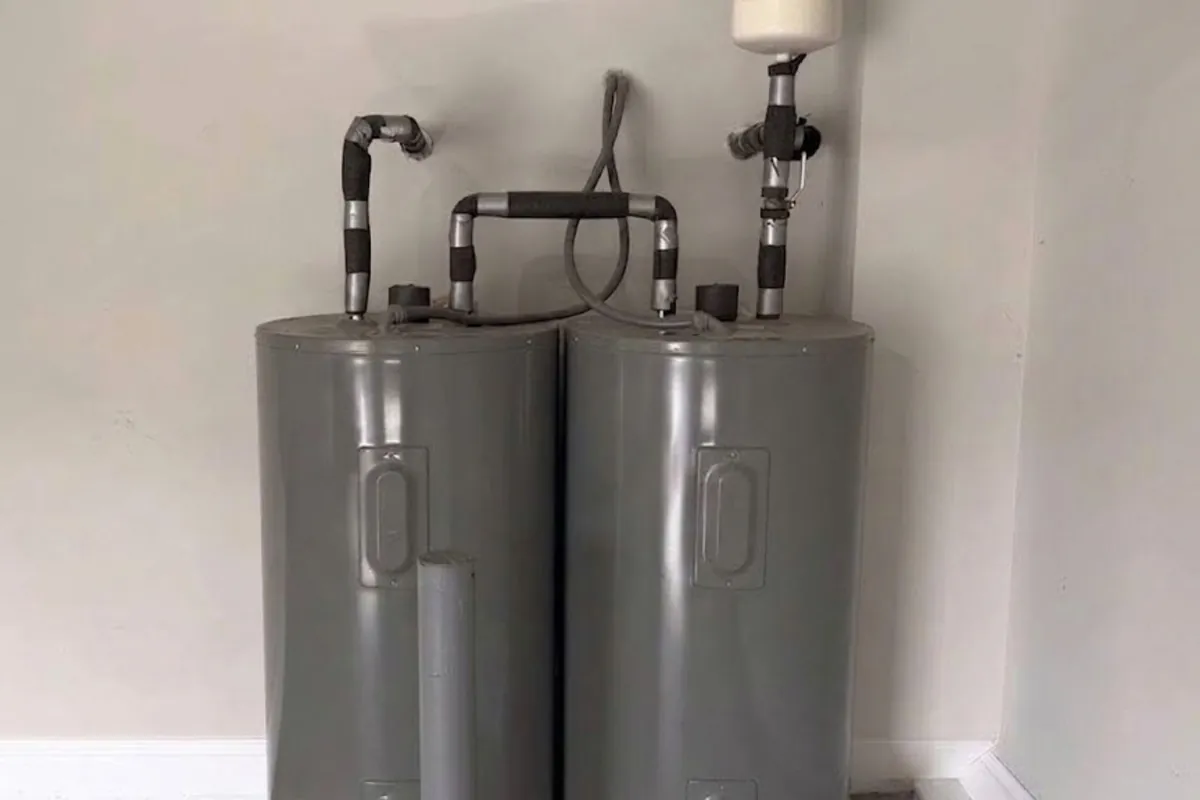
If the tank is leaking or you smell gas
Some water heater problems are urgent. Take these steps before anything else.
- If you smell gas, leave the house, do not flip switches, and call Intermountain Gas from outside.
- For a leaking tank, close the cold water valve on the pipe above the heater.
- Turn a gas heater's control to the pilot or off setting.
- For an electric heater, switch off its breaker at the panel.
- Move boxes and anything stored near the tank off the floor.
A steady drip from the pipe on the side of the tank is the temperature and pressure relief valve. The Uniform Plumbing Code (UPC) requires that valve on every tank heater, along with a discharge line to a safe spot. That valve is doing its job, and it usually means pressure in the tank is too high, so do not cap it.
When a water heater problem can't wait until morning
A tank that is actively leaking, a relief valve that keeps discharging, or a gas smell near the burner are the three water heater calls our 24/7 line treats as emergencies. A heater that simply went cold overnight is usually a next-morning job, and we will tell you which one you have.
Water pooling at the base
Close the cold inlet valve on top of the tank and turn the heater off. A garage floor can hold a lot of water before it reaches drywall, but a crawl space heater cannot.
Relief valve spraying or dripping hard
Do not cap or plug it. A steady discharge means pressure or temperature is too high, and the heater should be shut down until it is checked.
Rotten egg smell by a gas heater
Leave the area and call Intermountain Gas first. Once the utility clears the line, we can repair or replace the control valve or burner parts.
No hot water and nothing leaking
Check the breaker or pilot first. If that does not bring it back, this can usually wait for a daytime visit at a regular rate.
How Meridian's water wears out water heaters
Meridian's city wells deliver water with a hardness of 6.97 to 10.53 grains per gallon, depending on your zone. When that water is heated, calcium and magnesium drop out as scale and settle at the bottom of the tank.
On a gas heater, that layer of sediment sits between the burner flame and the water. It causes the popping and rumbling sound many Meridian homeowners describe, and it makes the burner run longer for the same amount of hot water.
On an electric heater, scale coats the lower element until it overheats and burns out. A failed lower element is one of the most common repairs we make here, and it is usually a straightforward fix.
Scale also eats the anode rod faster. That rod is a metal sacrificial part that corrodes so the steel tank does not. Once it is gone, the tank itself starts to rust.
Homes built during the 2010s boom in Star are reaching the age when these same element and valve repairs start coming up.
On-demand units have their own failure points, covered on our tankless service page.
The same scale problem shows up across Ada County, in garage water heaters from Old Town Meridian to the subdivisions off Ten Mile Road.
The same scale-related repairs come up in Spurwing-area custom homes and in starter homes near Settlers Park, since the city water is hard across every zone.
Common problems and the usual fix
These are the repairs a plumber most often makes on tank water heaters in Meridian homes.
| Symptom | Likely cause | Typical repair |
|---|---|---|
| No hot water, gas heater | Pilot, thermocouple, or flame sensor | Clean or replace the failed part. |
| No hot water, electric heater | Tripped reset, burned element, thermostat | Replace element or thermostat. |
| Hot water runs out fast | Sediment buildup or a broken dip tube | Flush the tank or replace the dip tube. |
| Popping or rumbling | Scale layer at the bottom of the tank | Flush, then set a flushing schedule. |
| Relief valve dripping | High pressure or thermal expansion | Test pressure, add or recharge an expansion tank. |
| Rusty or smelly hot water | Depleted anode rod | Replace the anode, sometimes with a different type. |
| Water pooling under the tank | Corroded tank | Replacement, since a tank cannot be patched. |
Diagnosis is confirmed on site before any part is replaced.
Repair or replace? An honest rule of thumb
If the heater is under about eight years old and the tank itself is sound, a repair almost always makes sense. Thermocouples, elements, thermostats, and valves are replaceable parts.
If the tank is leaking from the body, no repair will hold. The same goes for a heater past 12 years with a rusted base, where a new part today often leads to another call next winter.
When replacement is the better answer, we will explain why and give you the price for a new water heater installation. You decide, and we will not push a replacement on a heater that a repair can save.
What changes the cost of a water heater repair
Most repairs are priced by the part and the time needed. These are the factors that make one repair cost more than another.
- Gas or electric, and which part has failed.
- Whether the part is in stock or model-specific.
- Access, since a crawl space or tight closet takes longer than a garage.
- Whether the tank needs flushing before the repair can be tested.
- Emergency timing versus a scheduled daytime visit.
Home insurance generally covers sudden water damage from a failed heater but not the heater itself. Call (208) 679-8357 and we will give you a price before any work begins.
Gas and electric heaters fail differently
Knowing your heater type narrows the likely cause before anyone arrives.
| Heater type | Common failure | What you might notice |
|---|---|---|
| Gas tank | Thermocouple or flame sensor | Pilot will not stay lit, no hot water. |
| Gas tank | Sediment over the burner | Rumbling, slow recovery. |
| Electric tank | Lower heating element | Hot water runs out quickly. |
| Electric tank | Thermostat or reset trip | No hot water, reset button popped. |
| Either type | Relief valve or expansion issue | Dripping discharge pipe. |
Common failure points by heater type.
Before calling about an electric heater with no hot water, check the breaker and press the red reset button behind the upper access panel with the power off. If it trips again, the element or thermostat needs attention.
How to find your water heater's age
The manufacture date is coded into the serial number on the label. Many brands use a letter for the month and two digits for the year, while others start the serial with the year and week. The manufacturer's website usually explains its format.
Knowing the age changes the repair conversation. A three-year-old tank with a bad element is an easy repair. A 13-year-old tank with the same problem may be better replaced, since the tank itself is near the end of its life.
Maintenance that extends heater life in Meridian
Flush the tank once a year, or twice in the harder zones. Test the relief valve by lifting its lever briefly each year. Have the anode rod checked every three to four years.
If your home has a water softener, the anode may wear even faster, so inspect it more often. A softener also greatly reduces the scale that shortens heater life.