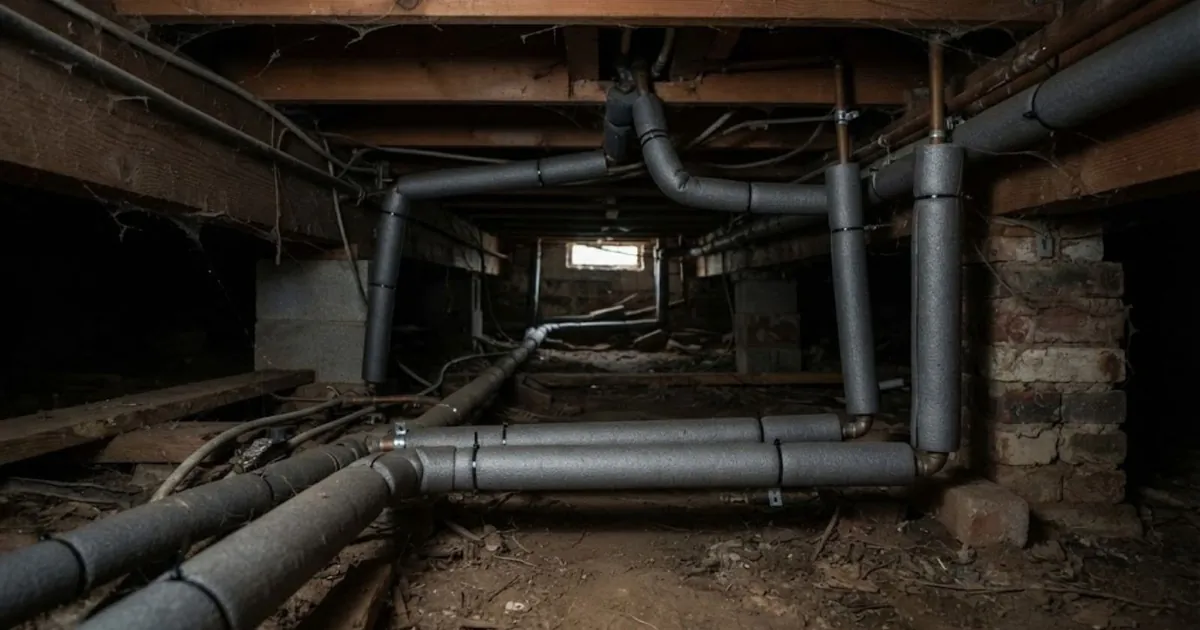
Why crawl spaces are the weak point
A crawl space is inside the foundation but outside the heated part of the house. In summer, foundation vents let moist air escape. In winter, those same vents let freezing air in, and the coldest spots are right along the perimeter where the pipes often run.
The city's own winter guidance says to insulate pipes in unheated areas, including crawl spaces, and notes that the main shutoff is typically located there. That makes the crawl space both the most likely place for a freeze and the place you will go to stop one.
The fall crawl space checklist
Do this in October, before the first hard freeze. Wear gloves and bring a flashlight.
- Close or cover every foundation vent, including any that were propped open for summer.
- Check that the crawl space access door closes tightly.
- Follow each supply line from where it enters to where it rises into the house.
- Look for insulation sleeves that have slipped, split, or been knocked off.
- Pay extra attention to lines within a few feet of an exterior wall or vent.
- Check the lines that feed exterior hose bibs, since they run to the outside wall.
- Look for damp soil or drips that suggest an existing leak.
- Confirm you can reach the main shutoff without crawling over obstacles.
Protection options, from simplest to strongest
Most homes need only the first two. Lines that have frozen before may need more.
| Option | What it does | Best for |
|---|---|---|
| Close vents and seal gaps | Keeps the coldest air out | Every home, every winter. |
| Foam pipe insulation | Slows heat loss from the pipe | Exposed lines in the crawl space. |
| Self-regulating heat cable | Adds heat only when the pipe gets cold | Lines that have frozen before or sit near vents. |
| Rerouting a line | Moves it away from the coldest wall | Chronic problem spots. |
Match the protection to how exposed the line is.
Heat cable must be a type rated for the pipe material and installed per the manufacturer's instructions. Never wrap it over itself, and plug it into a protected outlet.
During a hard cold snap
Keep the thermostat steady, even at night. The city recommends heating every room that has plumbing fixtures and leaving interior doors open so warm air reaches pipes on exterior walls. Keep the garage door closed if pipes run through it.
Opening cabinet doors under sinks on outside walls helps too. A slow drip at a faucet fed by an exposed line is a reasonable backup, since moving water is slower to freeze.
If you are leaving town, keep the heat at 55 degrees or higher. Consider shutting off the main while you are away so a split pipe cannot flood the house.
If a line freezes anyway
Open the faucet the line feeds, and warm the pipe gently with a hair dryer or space heater, starting nearest the faucet. The city is explicit: never thaw a pipe with an open flame. Our frozen pipe repair service can locate and thaw lines you cannot reach.
If you see water or hear spraying when the line thaws, close the main shutoff immediately. The pipe has split, and burst pipe repair is the next step.
The spring check that finds winter damage early
In April, reverse the fall routine. Open the foundation vents again so the crawl space can dry out through the summer, and take a second look at the lines you checked in October.
Look for water stains on the soil or vapor barrier, insulation sleeves that are wet or sagging, and any white mineral trails on pipes or fittings. A slow drip that started after a freeze can go unnoticed for months under the house.
Run the meter test once in spring as well. With every fixture off, the leak indicator on the water meter should sit still. If it moves, something is leaking, and the crawl space is the first place to look.
Leaving home in winter
Many freeze bursts happen while owners are away and no one notices for days. A short routine before a winter trip prevents most of them.
- Keep the thermostat at 55 degrees or higher, never off.
- Close the main shutoff and open a faucet briefly to relieve pressure.
- Switch a gas water heater to vacation or pilot mode.
- Leave cabinet doors open under sinks on exterior walls.
- Ask someone to check the house every few days during a cold snap.
With the main closed, a split pipe leaks only the water already in the lines instead of flowing for days.
A note for owners of newer homes
New homes freeze too. A builder may leave foundation vents open for curing, or insulation may be missing on a short run nobody noticed. Owners in their first winter are the least likely to know the routine.
That is common in the fastest-growing parts of the valley. In Star, where much of the housing was built in the last decade, first-winter freeze calls follow exactly this pattern.
Meridian notes: how cold it gets here
Boise Airport, the closest official station, has a normal January low of 25.5 degrees, and January averages 25.5 nights at or below freezing. December is close behind at 25.2.
Across a year the station averages 108.2 nights at or below 32 degrees, and the median last spring freeze is April 24. Crawl space vents that were closed in fall should stay closed until then.
Meridian's building design criteria use a winter design temperature of 10 degrees and require footings at least 24 inches deep for frost. The same cold reaches crawl spaces in Eagle and the rest of the valley.