Step 1: rule out the obvious
Before hunting for a leak, make sure the higher bill is not explained by use.
- Compare the same month last year, not just the previous month.
- Check whether summer sprinkler use on city water explains the jump.
- Consider guests, a new family member, or a filled pool or hot tub.
- Confirm the bill is based on an actual reading, not an estimate.
If none of those explain it, something is using water you do not see.
Step 2: the meter test
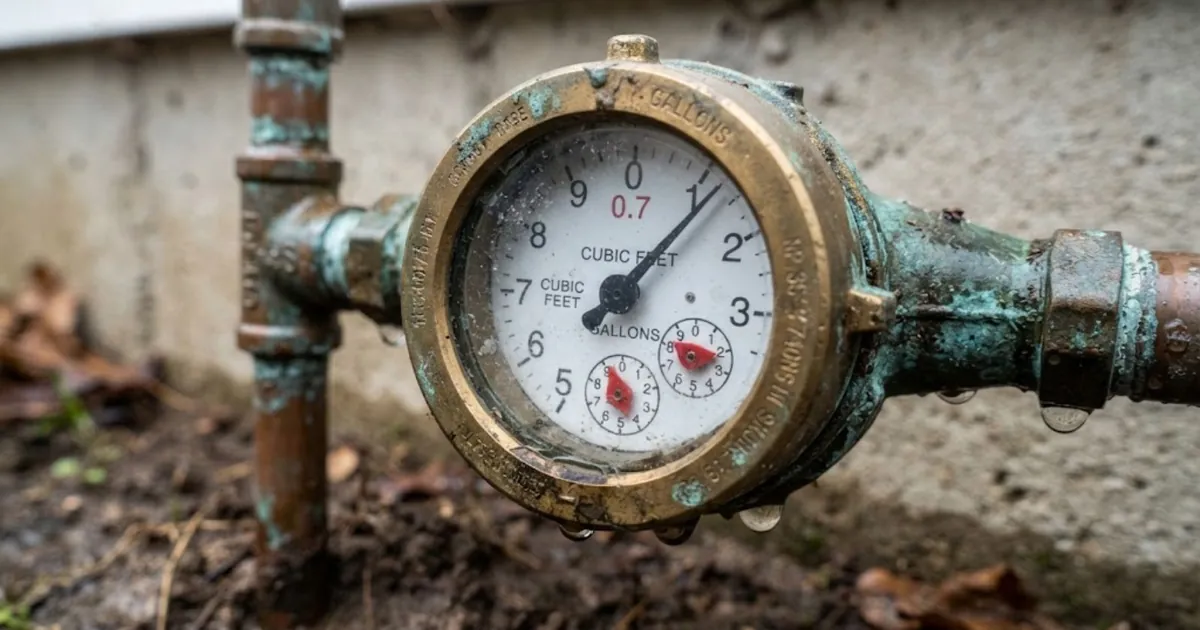
Your water meter is usually in a covered box near the street. Turn off every faucet, the dishwasher, the washer, the softener if it is regenerating, and the sprinkler system. Then open the meter box and watch the small leak indicator, often a triangle or star-shaped dial.
If the indicator moves, water is flowing somewhere. Next, close the main shutoff at the house and look again. If it stops, the leak is inside the house. If it keeps moving, the leak is between the meter and the house, in the buried service line.
A leak on the street side of the meter, or at the meter itself, belongs to the city. Call Meridian Water at 208-888-5242 for that. Everything from the meter to the house is the owner's responsibility.
Step 3: if the leak is inside, check these
These are the most common indoor causes, roughly in order of how often they turn up.
| Source | How to check | How much it can waste |
|---|---|---|
| Running toilet | Add food coloring to the tank, wait 15 minutes without flushing | A lot, since it runs day and night. |
| Dripping faucet or showerhead | Look and listen with everything off | Small individually, adds up over months. |
| Water heater relief valve | Check the discharge pipe for a steady drip | Moderate, and it signals a pressure problem. |
| Softener stuck in regeneration | Listen for water running to the drain | Can be large if it cycles constantly. |
| Hidden pipe leak | Damp spots, musty smell, warm floor spots | Varies, and it damages the house. |
Typical indoor causes of a high bill.
Toilets are the usual suspect. A worn flapper lets water leak into the bowl so the tank keeps refilling, and Meridian's hard water speeds up that wear. Our toilet repair service fixes most of these in one short visit.
Step 4: do not forget the sprinklers
If your sprinklers run on city water, they can be the biggest source of a surprise bill. A zone valve with debris in it may not close completely, leaving one zone trickling all night. A cracked lateral line after a freeze can leak underground without any visible spray.
Look for a patch of lawn that stays soggy or unusually green, heads that seep water after the cycle ends, or a valve box with standing water. Run the meter test with the sprinkler system on standby and again with its supply valve closed to see whether it is the source.
Step 5: when to call for leak detection
If the meter test shows a leak but the toilets, fixtures, and sprinklers all check out, the leak is hidden. It may be in a crawl space, inside a wall, under a slab, or in the yard. That is when professional equipment earns its cost, because it finds the spot without opening walls or digging trenches to search.
Our leak detection service uses pressure testing, acoustic listening, and thermal imaging to pinpoint the leak before anything is opened. Homes on larger lots, common on the edges of Kuna and south Meridian, often have longer service lines where a slow leak can hide for weeks.
Two less obvious water users
A water softener that gets stuck in regeneration can send water to the drain for hours. You may hear water running near the softener in the garage when nothing else is on. Checking the control head or unplugging and restarting it often ends the cycle, and a service call fixes a failing valve.
Sprinkler controllers are the other quiet culprit. A controller that reset to a default program after a power outage may be watering every day instead of every few days. Check the schedule after any outage, and look at the rain sensor if you have one.
Keep an eye on use going forward
Once the leak is fixed, a simple habit catches the next one early. Read the meter at the same time on two evenings a week apart and note the difference. You will quickly learn what normal looks like for your household in each season.
A sudden jump between readings, with no guests or extra watering to explain it, is the earliest warning you will get. It usually shows up long before the next bill arrives.
After the leak is fixed
A few follow-ups help you confirm the problem is solved.
- Repeat the meter test a day after the repair.
- Watch the next bill for a return to normal.
- Keep receipts in case your utility offers a leak adjustment.
- Check toilet flappers yearly, since hard water keeps wearing them.
Meridian notes: what a leak costs on a Meridian bill
From October 1, 2026, Meridian charges $2.25 per 1,000 gallons for water and $6.23 per 1,000 gallons for sewer, plus base fees of $7.05 and $10.02. Bills show use in 1,000-gallon increments.
The city has an online billing adjustment request, but it will not consider an adjustment until the leak is repaired. Attach the repair receipt to the request, and call Utility Billing at 208-888-4439 with questions.
In Garden City, the City of Garden City or Veolia may serve your street, so check your own bill for that supplier's rates and adjustment rules.