Where to look, in order
Start where the water line enters the house. In Meridian that is usually the side facing the street.
- The crawl space, near the foundation wall closest to the street, where the supply line comes up through the soil.
- A closet or utility area on the street side of the house, sometimes behind an access panel.
- The garage, near the water heater or where the line enters through the slab.
- Near the water softener, if you have one, since it sits on the main line.
- Outside, the curb stop inside the meter box by the street, which may need a meter key.
When you find it, tag it with a bright label and show everyone in the house. The city specifically recommends telling all household members where it is.
What the valve looks like
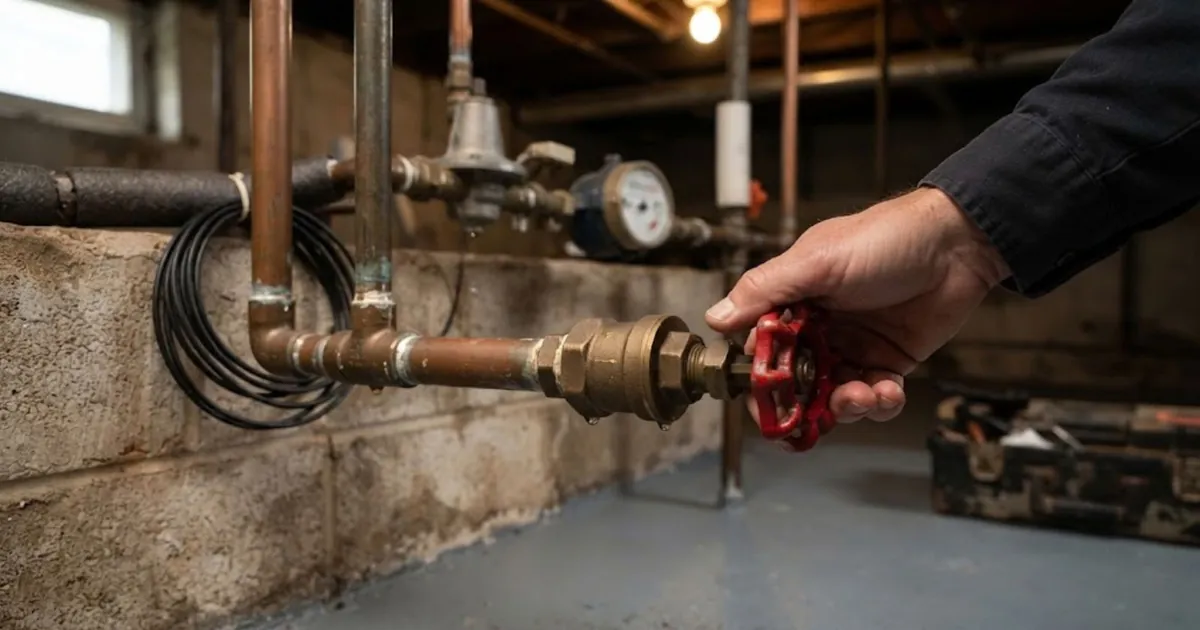
There are two common styles. Knowing which you have tells you how to close it.
| Valve | How to recognize it | How to close it |
|---|---|---|
| Ball valve | A lever handle in line with the pipe when open | Turn the lever a quarter turn so it sits across the pipe. |
| Gate valve | A round wheel handle | Turn clockwise several full turns until it stops. |
| Curb stop | A valve deep in the meter box, often with a slotted top | Turn a quarter turn with a meter key. |
Common main shutoff valve types.
Gate valves are common in older homes and are the ones most likely to be stuck or to leak at the stem after years of not being used. Ball valves are more reliable and are what most plumbers install today.
If the valve will not turn
Do not force a stuck gate valve with a wrench. Old valves can snap at the stem, which turns a small problem into a flood you cannot stop. Try firm, steady pressure by hand. If it does not move, go to the curb stop at the meter box instead.
A stuck or leaking main valve is worth replacing on a normal weekday, before an emergency. It is a small job that pays for itself the first time a pipe fails. Older homes are the most likely to need it, especially in neighborhoods like Garden City, where many houses date from the 1950s to the 1970s.
About the curb stop and the meter box
The curb stop sits in the meter box, usually near the street or sidewalk. It shuts off water before it reaches your service line, which makes it the right valve when the leak is in the yard between the meter and the house.
It often needs a long meter key to reach, and the box can be full of soil or ice in winter. If the problem is at the meter itself or on the street side, call Meridian Water at 208-888-5242. Leaks between the meter and the house are the owner's responsibility, and our water line repair page covers that section.
A five-minute practice drill
Doing this once a year keeps the valve working and makes sure everyone knows the routine.
- Find the valve and clear anything stored in front of it.
- Close it fully and open a faucet to confirm the water stops.
- Reopen it slowly to avoid a pressure surge.
- Check the valve stem for drips after reopening.
- Show the valve to everyone who lives in the home.
If the valve will not close completely or drips afterward, have it replaced.
Label it and make a simple house map
Once you know where the main shutoff is, write it down. A single sheet taped inside the garage or a utility closet door is enough: where the main is, where the water heater shutoff is, and where the shutoff for the sprinkler system sits.
Add the curb stop location and a note about whether you own a meter key. Include the fixture shutoffs that are hard to find, such as the valve for the ice maker line or the one behind the washing machine.
This matters most when you are not the one at home. A house sitter, a teenager, or a neighbor checking on the house during a trip can stop a burst pipe in minutes if the map is there. Without it, they may spend the first half hour searching while water runs.
If you rent your home
Renters face the same leaks with less information. Ask your landlord or property manager where the main shutoff is when you move in, and whether there is anything in the way of reaching it, such as a locked crawl space access.
If the shutoff is in a crawl space you are not allowed to enter, ask where the curb stop is and whether a meter key is available. Save the landlord's emergency number next to the location notes.
In an emergency, stopping the water comes first. Then notify the landlord right away and document the damage with photos, which protects both you and them.
When a pipe actually bursts
Close the main first, then open a faucet on the lowest floor to drain pressure. Turn off power to wet rooms. Switch the water heater to pilot or turn off its breaker if the water will be off for a while.
Then call. Our burst pipe repair service is answered 24/7 and can walk you through these steps on the phone if you are still looking for the valve.
Meridian notes: where the city's part ends
The city's responsibility ends at the water meter. From the meter back to the house, the water and sewer lines belong to the owner, and from the meter to the street they belong to the city.
Idaho's plumbing code requires building supply piping in the yard to have at least 42 inches of cover, which is why the service line is rarely the first thing to freeze. The house shutoff and exposed lines inside are another matter.
The city targets 55 to 80 psi at homes and uses pressure zones because pressure in the lowest areas of town could otherwise top 200 psi. If the shutoff is buried or seized, we replace it in Meridian and Kuna with a quarter-turn valve.