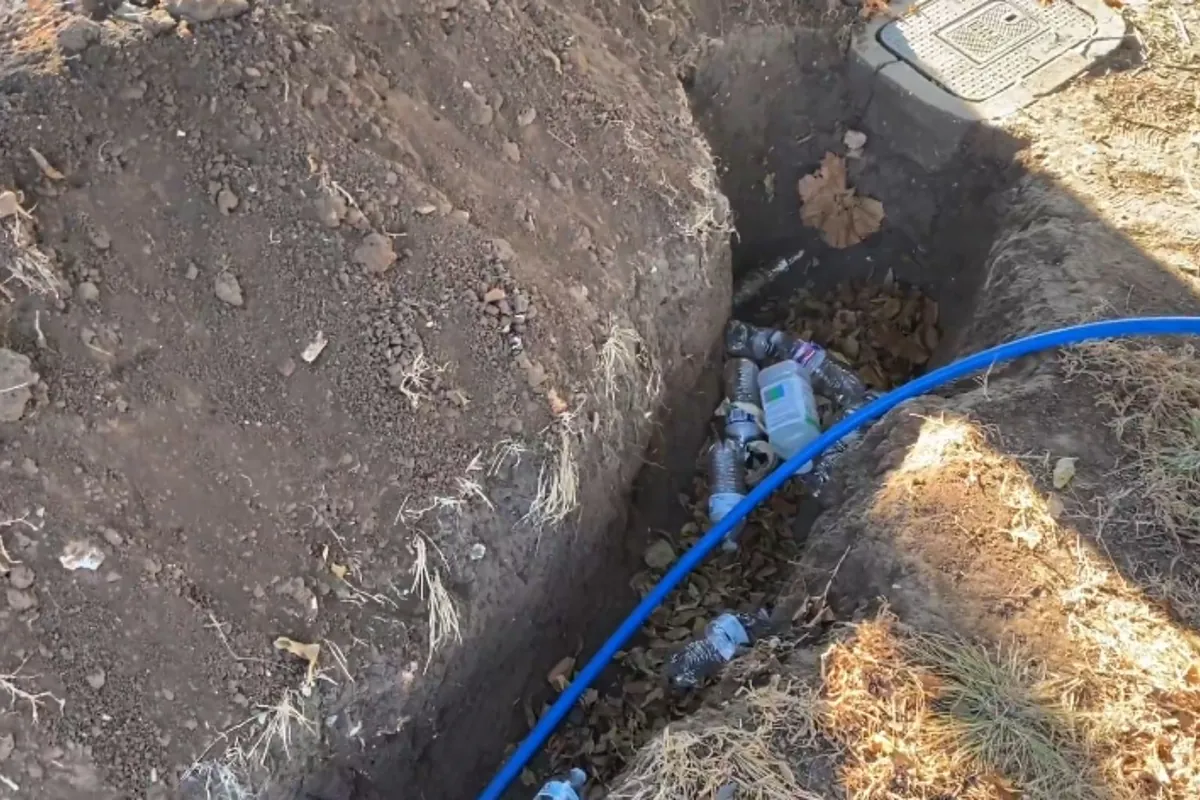
Which part of the line is yours?
In Meridian, the city maintains the water lines in the public right of way, including the main in the street. The service line on your side, from the meter to the house, is the owner's responsibility.
If the leak is at the meter itself or on the street side, call Meridian Water at 208-888-5242. They handle their portion at no cost to you.
Everything from the meter to the house is private plumbing. That is the part a plumber repairs, and it is usually the part that fails.
Ownership works differently in Eagle, where the utility that owns the meter depends on which water provider serves your street.
If the meter test shows the leak is inside the house instead, leak detection is the next step, and a pipe that split in the cold is covered under burst pipe repair.
Service lines in Ada County's older neighborhoods near Main Street are the most likely to be galvanized.
Larger lots on the edges of town, such as those near Spurwing, often mean longer runs from the meter than in the compact blocks around Storey Park.
Service line emergencies: water in the yard or no water at all
A broken service line shows up two ways. Either water is bubbling up through the lawn or driveway, or the house suddenly has no water while the neighbors still do.
If water is surfacing in the yard, close the main shutoff at the house first. If that does not stop it, the leak is between the meter and the shutoff, and the meter valve has to be closed. Call (208) 679-8357 and we will walk you through it.
Our 24/7 crew locates the break and repairs the section the same night where the ground allows. A full replacement is quoted separately once the house has water again.
Signs your service line is leaking
Service line leaks are underground, so the signs are indirect.
- The meter's leak indicator moves even with the main shutoff at the house closed.
- A strip of lawn between the meter and the house stays green or soggy in a dry spell.
- Water pressure throughout the house has dropped over time.
- You hear running water near the foundation when nothing is on.
- The water bill rose without a change in use.
The meter test on our leak detection page is the fastest way to confirm whether the leak is between the meter and the house.
Service line materials in Meridian homes
The material depends largely on when your home was built.
| Material | Where it shows up | What to know |
|---|---|---|
| Galvanized steel | Older Old Town homes | Rusts from the inside, loses pressure, eventually leaks. |
| Copper | Many homes from the 1970s to 1990s | Durable but can pinhole, especially at bends. |
| Polyethylene (poly) | Many newer homes | Flexible and freeze tolerant, fittings can loosen. |
| PEX or PVC | Some newer service lines | Durable, depends on correct burial depth and fittings. |
General patterns. The actual material is confirmed when the line is exposed.
Repair a section or replace the line?
If the line is in good shape except for one leak, such as a loose fitting or a single puncture, a spot repair is usually the right call. The plumber locates the leak, digs a small pit, and replaces that section.
If the line is old galvanized steel, has leaked more than once, or is undersized for today's household, replacement makes more sense. A new line restores full pressure and resets the clock.
Replacement does not always mean a long trench. Depending on soil and distance, a new line can sometimes be pulled or bored under the yard between two small pits. Before any digging, buried utilities are marked through Idaho's 811 locate service.
Check the pressure regulator too
Many homes have a pressure reducing valve where the service line enters. If street pressure runs high and that valve has failed, the extra pressure strains every joint in the house and can shorten the life of a new line.
A plumber can test house pressure with a gauge on a hose bib in a few minutes. It is worth doing whenever the service line is repaired or replaced.
What affects the cost of water line work
Service line jobs vary mainly with distance and what sits on top of the pipe.
- The distance from the meter to the house.
- Whether the line runs under lawn, landscaping, a driveway, or a walkway.
- Spot repair versus full replacement.
- Trenching versus boring or pulling a new line.
- Permit, inspection, and surface restoration.
Call (208) 679-8357 and we will explain the likely approach and price before any digging starts.